Jiangling Motors Corporation, better known by its abbreviation JMC, is one of China’s oldest largely commercial vehicle brands having been founded in 1947.
Established track record
From making components, the brand produced its first vehicle, a light-duty truck, in 1968, before going into joint venture partnerships with Isuzu and Ford in 1993 and 1997 respectively.
ALSO READ: Returning JMC finally prices ‘below R300 000’ Vigus bakkie range
One of the number of original Chinese vehicle brands to enter South Africa, it quietly retreated some 10 years ago, before announcing its return in June last year under the auspices of importer, Salvador Caetano Auto South Africa.
Indirectly present in South Africa since 2024 via the Ford Territory, which it produces at its Nanchang plant for the Blue Oval under the Equator Sport moniker, the brand’s product line-up one consists of bakkies and light-duty trucks, but with plans already in place to compete in the entry and more premium bakkie segment.
Familiar name starts return off
Priced back in November, the JMC starts its return with the Vigus, which it previously offered as its premium step-up over the workhorse-focused Boarding.
Relaying on a mix of Ford and Isuzu input, the latest Vigus is based on the Chinese-market Yuhu 9, which debuted in 2019 as a facelift version of the Yuhu 7 that went on-sale two years before.
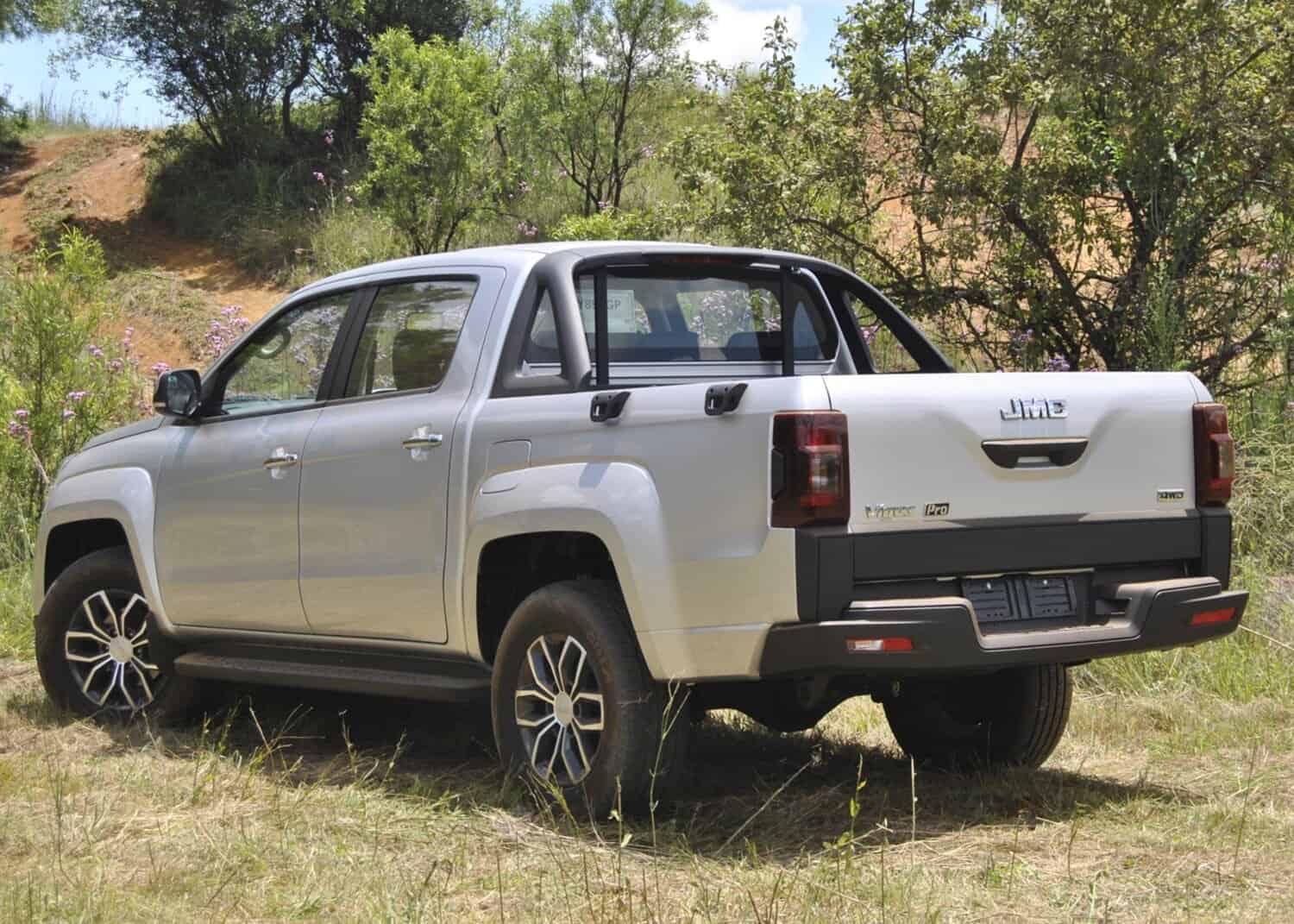
Known locally as the Vigus Pro, the range spans three models, a solitary single cab and two double cabs, both powered by different displacement versions of the earlier Ford Puma turbodiesel engine.
While the unveiling at the Lion & Safari Park outside Broederstroom on Johannesburg’s West Rand didn’t involve sampling the single cab, short on-and-off-road drives of the double cab did take place with varying levels of findings.
Range
Single cab
Positioned as the workhorse, the single cab Vigus Pro only comes in one trim level and with drive going to the rear wheels through a manual gearbox.
For the immediate future, this will be the only derivative available as no plans currently exist to offer it with an automatic gearbox or even four-wheel drive.
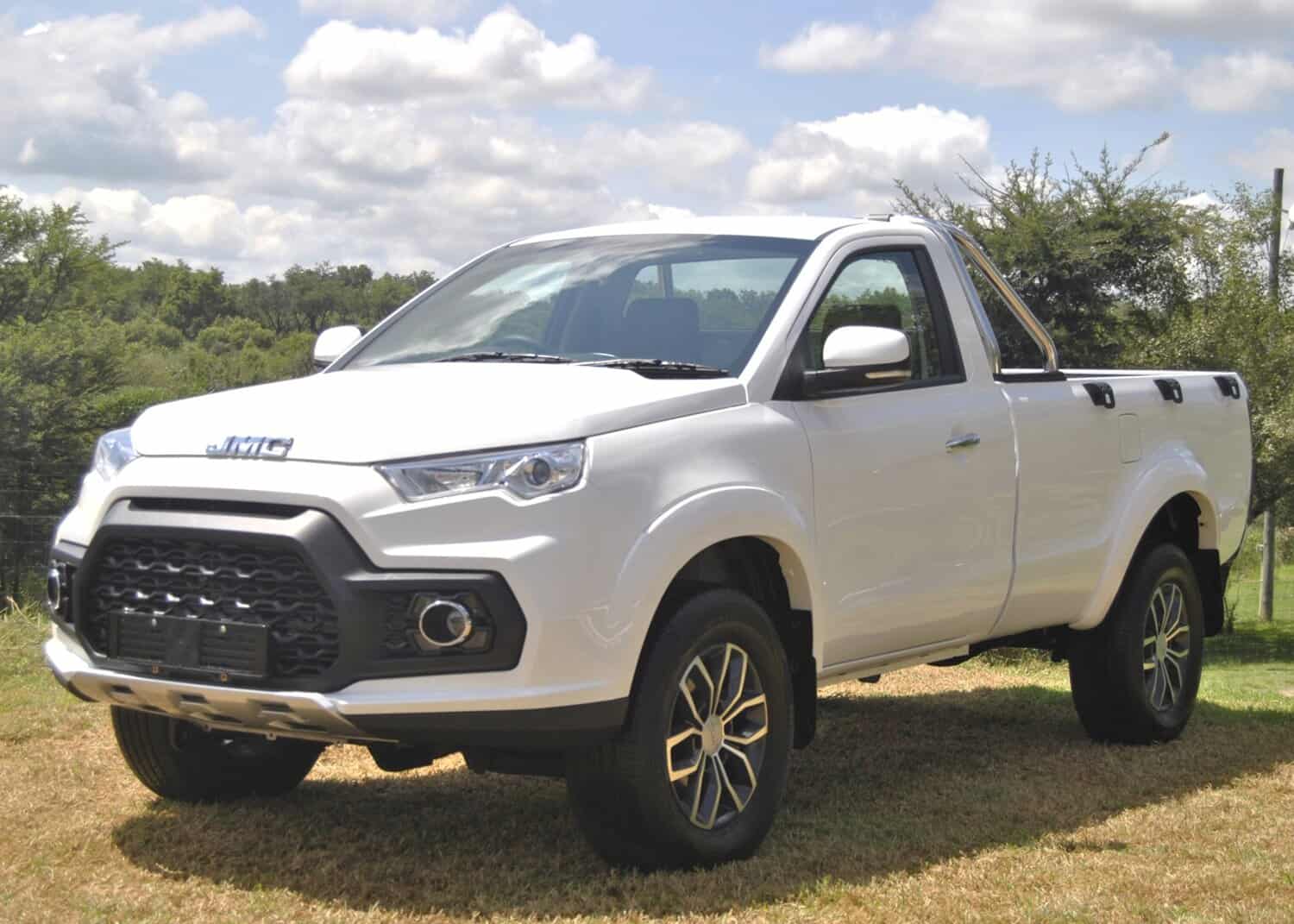
Up front, motivation comes from the Blue Oval’s 2.4-litre oil-burner once used locally in the previous generation Land Rover Defender.
For use in the Vigus though, JMC has upped the engine’s power from 90 kW to 103 kW, but reduced the torque from 360 Nm to 310 Nm.
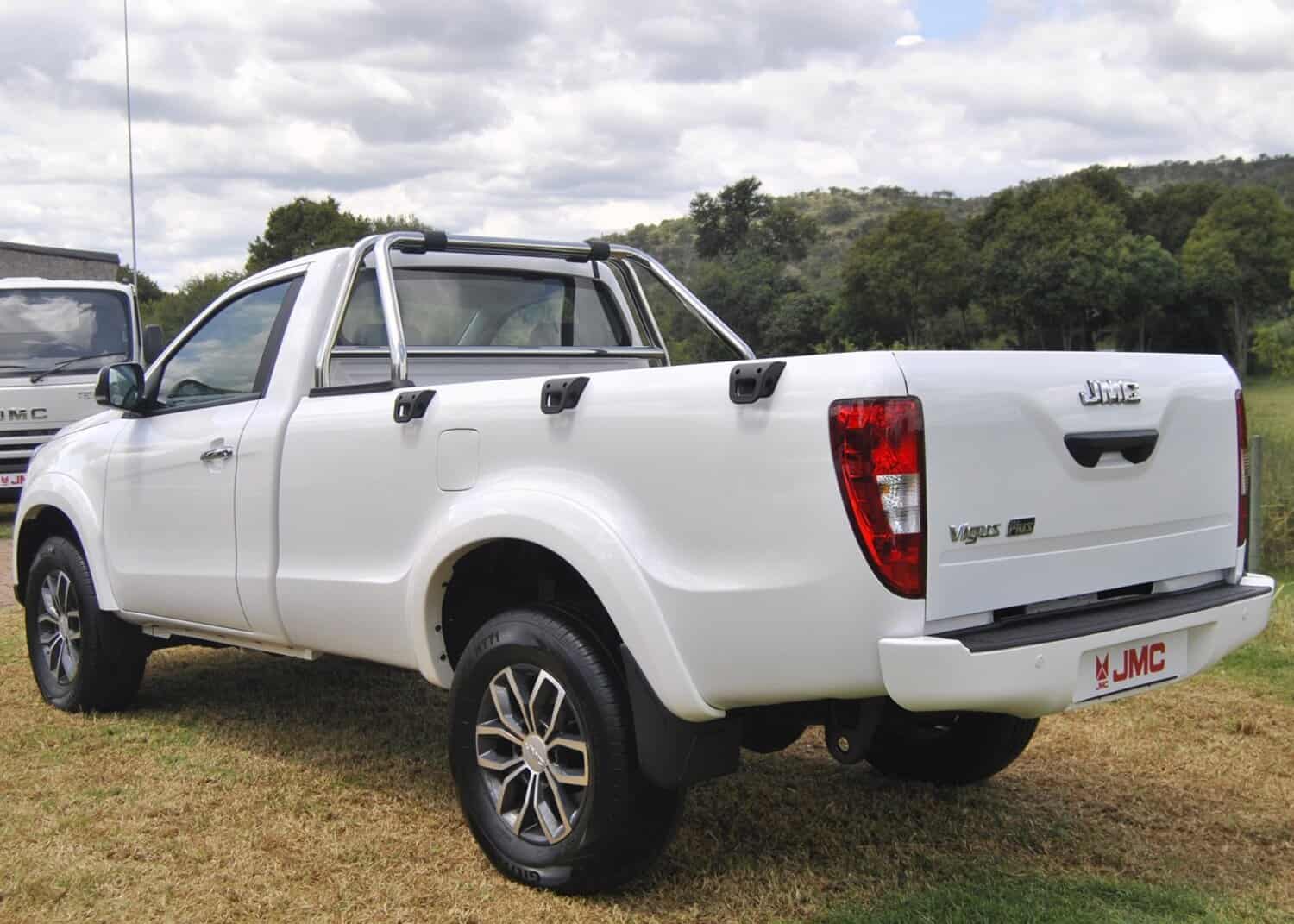
As well as the lack of the four-wheel drive system offered in the Defender, the ratio count in the Vigus’ gearbox has been dropped by one to five.
On the specification front, and despite its workhorse focus, the Vigus Pro single cab has been equipped well with, amongst others, 17-inch alloy wheels, a sports bar, LED daytime running lights, fog lamps and a rubberised loadbin.
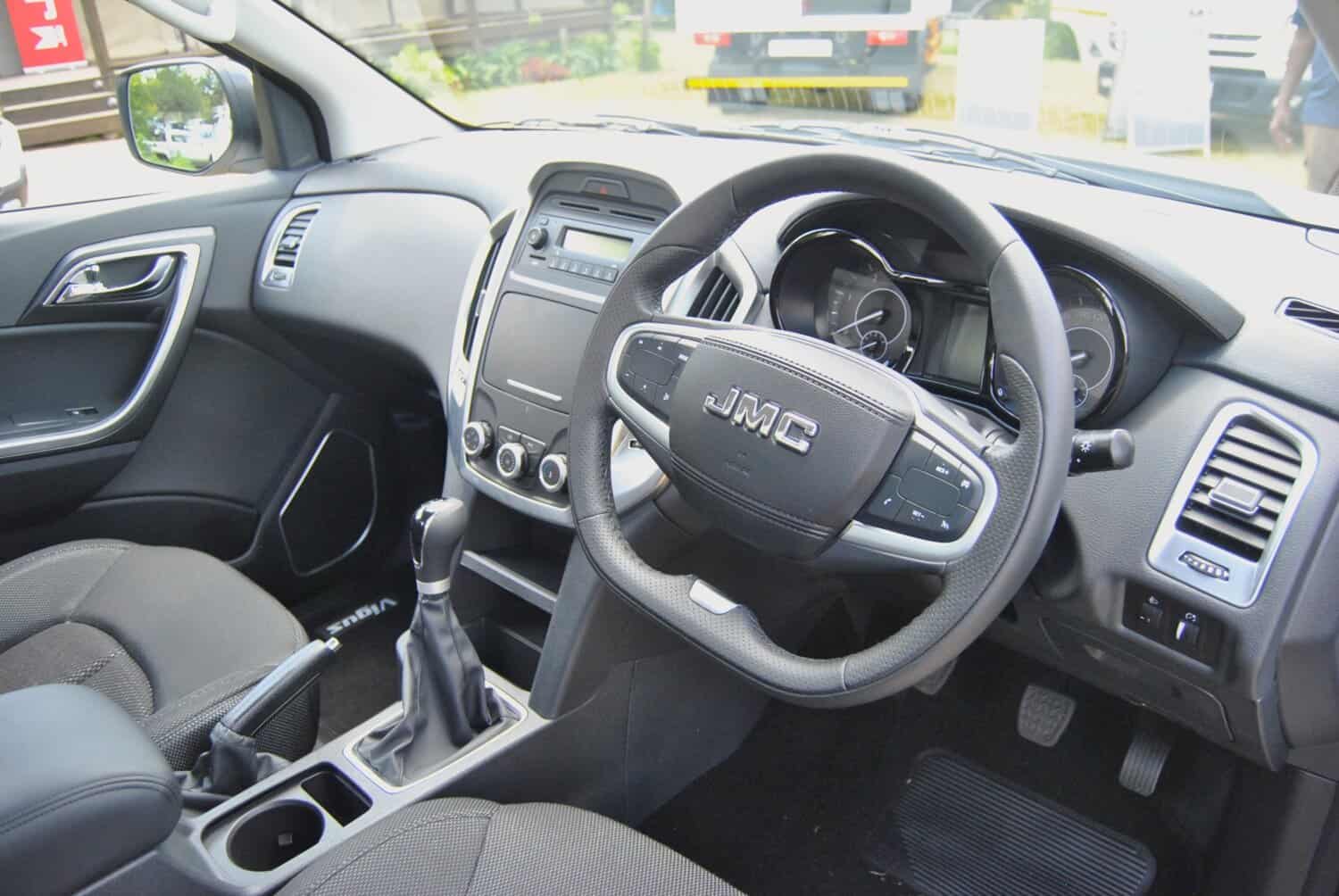
Inside, the list of creature comforts include:
- multi-function steering wheel;
- air-conditioning;
- electric windows;
- four-speaker sound system;
- single USB port;
- 3.5-inch instrument cluster display;
- electric mirrors;
- cruise control
Safety and driver assistance system comprises rear parking sensors, ABS and EBD, Electronic Stability Programme and somewhat strangely, only a driver’s side airbag.
Double cab
For the pair of double cabs, the Vigus swaps the 2.4-litre unit for the slightly newer 2.0-litre diesel that shares relations with the 2.2 that once powered the Ford Ranger and Mazda BT-50.
Given its reduction in displacement though, the unit outputs 104kW/350Nm and is connected solely to an eight-speed automatic gearbox.
Differentiating the double cab is done by the choice of two or four-wheel drive, the latter equipped with an Eaton locking differential, Hill Descent Control and a part-time all-paw gripping system with low range sourced from BorgWarner.
Compared to the single cab, the double cab’s added specification items include imitation leather seats, side-steps, paddle shifters, a passenger side airbag, reverse camera and a 9.7-inch infotainment display with wireless Apple CarPlay and Android Auto.
The drive
For the launch route, JMC had split the driving into two sections, a quick tar drive in the two-wheel drive, and a jaunt through the reserve to a off-road section with inclines and ruts for the four-wheel drive.
Sampling the latter first, initial thoughts point to the interior feeling dated and the mentioned infotainment system appearing almost aftermarket in look and layout.
Physical switchgear, thankfully, still dominates the interior and while cabin ergonomics are easy to fathom, the switch from left to right-hand drive has seen the handbrake remain fixed to what is now the passenger’s side instead of being located next to the driver.
Given its application, build quality and fit-and-finish proved acceptable as no untoward noises were noticed during the off-road escapade.
Once switched to 4H and later, low range or 4L, the Vigus easily negotiated the rutted and rocky uphill sections, only getting stuck once on a practically tricky section thanks completely to driver error.
As also noted by my driving partner, the ride felt hard, with the result that the Vigus lacks the comfort of most newer legacy brand bakkies.
Given its age though, and intended use as still more of a workhorse than leisure double cab, the outcome doesn’t come as a surprise.
On-road with the two-wheel drive, the Ford-sourced engine is no firecracker and delivers a steady rather than earth pounding flow of power.
Unnerving though was the whirring noise the engine emitted akin to a badly fitted belt or fan.
Not noticed during the slow trek through the reserve, wind noise intrusion, particularity from the rear window, was high and resulted in than more than a few instances of reaching for the buttons in trying to close the side windows.
Despite its firm ride, the Vigus still felt suitability on-road, which could possibility attributed to the two-wheel drive having had different pressures to the four-wheel drive.
Nonetheless, and despite its powerunit oddity, the eight-speed ‘box proved effortless, though, the lack of a conventional manual override using the Peugeot-esque gear lever proved somewhat odd.
In fact, selecting gear manually, either in full or semi-automatically, only happens via the paddle shifters.
Conclusion
Priced from R299 900 to R499 900, the JMC Vigus Pro isn’t targeted at the main legacy brand bakkies, or even the GWM P-Series, but rather at the lower-end of the segment frequented by the GMW Steed, Mahindra Pik Up, Foton Tunland G7 and JAC T6 and T8.
While the upmarket role will be fall to two completely different products arriving later this year, the Vigus Pro makes no excuse for its largely workhorse-focused intentions, while still being well equipped with just the correct number of features for the price.
In this regard, it offers good value and, given the rapid rise in acceptance of especially Chinese bakkies, a real threat to the locally-made Mahindra as well as its other countrymen.
Price
All Vigus Pro models come standard with five-year/100 000 km warranty, with three-year/50 000 km service plan included on the double cab but optional on the single cab.
- Vigus 2.4D single cab – R299 900
- Vigus 2.0D double cab AT – R439 900
- Vigus 2.0D double cab 4×4 AT – R499 900
NOW READ: Salvador Caetano Auto South Africa announces return of JMC